Something Is Broadcasting and Nobody's Talking: America's Phantom Frequency Problem
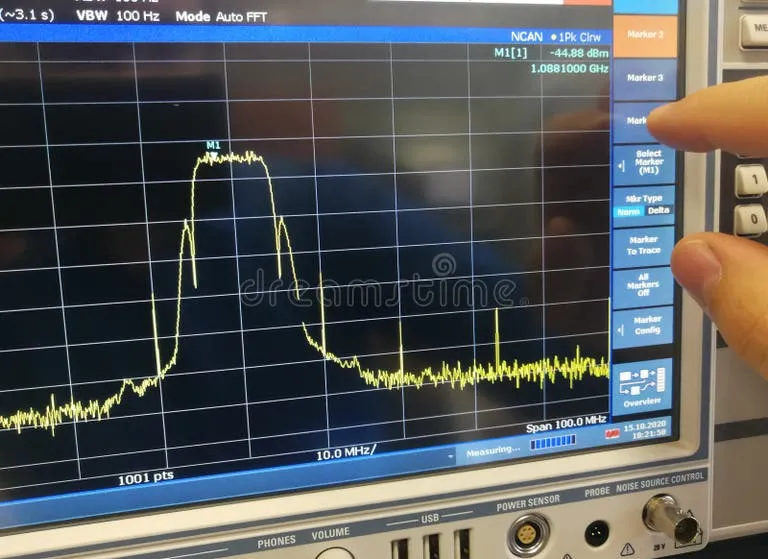
Photo: radio frequency spectrum analyzer glowing screen dark room, via thumbs.dreamstime.com
There's a frequency somewhere between the static and the silence where something is talking. It doesn't care if you're listening. It doesn't respond when you call back. It just transmits — steady, patient, and weirdly consistent — like it's been doing this long before you showed up and plans to keep doing it long after you leave.
Welcome to the weird end of the radio dial.
The Signal You Can't Explain Away
Most people think of the radio spectrum as a pretty well-organized place. The FCC hands out licenses. Corporations pay for bandwidth. Broadcasters file paperwork. There's a whole bureaucratic scaffolding designed to make sure every signal has a name and address attached to it.
Except — it doesn't always work out that way.
Amateur radio operators across the US have spent years cataloging transmissions that don't match any registered source. Not pirate FM stations playing cumbia out of someone's garage. Not a neighbor's busted garage door opener bleeding into your scanner. These are structured signals — often repeating at precise intervals, sometimes carrying what sounds like encoded data, occasionally shifting frequencies in ways that suggest intentional coordination.
The community calls them phantom signals, bandwidth ghosts, or sometimes just "unattributed." The FCC's public database calls them nothing, because officially, they don't exist.
UVB-76 and the Mythology of the Numbers Stations
To understand why this matters, you kind of have to start with UVB-76. If you've spent any time in the shortwave listening community, you already know the name. For the uninitiated: UVB-76 is a Russian-origin signal — sometimes called "The Buzzer" — that has been broadcasting a repetitive buzz tone on 4625 kHz almost continuously since the late 1970s. Occasionally it interrupts itself to read out a string of numbers and names in Russian. Nobody outside of whatever agency operates it knows exactly why.
UVB-76 became famous partly because it's been going so long without a credible public explanation, and partly because every time it deviates from its normal pattern, the internet collectively loses its mind for 48 hours. It's become a kind of cultural shorthand for the entire numbers station phenomenon — the idea that governments and intelligence agencies maintain these deliberately cryptic broadcasts as a communication channel for operatives in the field.
But UVB-76 is Russian. It's far away. It feels safely exotic.
The signals American hobbyists are tracking feel a lot closer to home.
Mapping the Domestic Weirdness
Over the past decade, a loose network of citizen signal analysts — some affiliated with organized groups like the North American Shortwave Association, others just solo listeners with a software-defined radio dongle and too much free time — have been building informal databases of anomalous domestic transmissions.
The methodology is pretty grassroots. Someone notices something strange, posts it to a forum or Discord server, other listeners try to reproduce it from different geographic locations to triangulate the source, and the data gets logged. It's not peer-reviewed science. It's not even particularly systematic. But the volume of documented cases has grown to the point where dismissing all of it as equipment error or misidentification gets harder to justify.
Some of what's been logged is genuinely strange. There are repeating tones on frequencies that the FCC database shows as unoccupied. There are data bursts — short, structured transmissions that pattern-match to known digital radio protocols but don't decode cleanly into anything readable. There are carrier signals — basically, a radio frequency that's just... on, but silent, waiting — that have been tracked to apparent origin points near major infrastructure installations.
In the Pacific Northwest, listeners have documented a recurring signal near certain military-adjacent facilities that appears and disappears on a rough monthly cycle. In the upper Midwest, there's a low-frequency anomaly that several independent operators have logged, which doesn't match the signature of any known navigation or time-signal broadcast. Along the Eastern Seaboard, there are clusters of unattributed transmissions that some analysts believe may be related to submarine communication infrastructure — though proving that is basically impossible for a civilian with a radio and a laptop.
Why Won't Anyone Just Explain This?
Here's where the story gets genuinely interesting, and genuinely frustrating.
The FCC has a process for filing interference complaints. If you're a licensed operator and you're picking up something that's messing with your designated frequency, you can report it. Sometimes the FCC investigates. Sometimes the interference disappears before they get around to checking. Sometimes they conclude the source is unidentifiable and close the case.
What doesn't happen — almost ever — is a public explanation. The agency isn't in the habit of publishing detailed reports on unattributed transmissions, especially when those transmissions don't appear to be causing licensed operators any actual interference. If a phantom signal is sitting on a technically unoccupied slice of spectrum and not bothering anyone with a license, it's basically invisible to the regulatory process.
Large telecom infrastructure companies — the ones that operate the physical towers and relay equipment that blanket the country — are even less forthcoming. Requests from journalists and hobbyists asking about anomalous signals near their infrastructure tend to disappear into PR black holes. The standard response, when there is one, is some variation of "we comply with all FCC regulations" — which sidesteps the actual question entirely.
There are boring explanations for some of this. Intermodulation interference, equipment malfunction, atmospheric ducting that carries foreign signals much further than normal. Signal analysts who've been doing this for decades will tell you that a significant percentage of "mysterious" transmissions eventually get explained by mundane technical factors.
But not all of them.
The People Who Keep Listening
What's notable about the community tracking these signals is how un-conspiratorial most of them actually are. These aren't people who think the government is beaming mind-control frequencies into their fillings. They're engineers, technicians, retired military communications specialists, and dedicated hobbyists who find the puzzle genuinely interesting regardless of what the answer turns out to be.
The appeal makes sense if you think about it. The radio spectrum is one of the last genuinely open frontiers in American information infrastructure. Anyone with a receiver can access it. The signals are real, physical things that exist in the world whether or not they show up in any official database. And the act of listening — really listening, carefully and systematically — feels like a form of paying attention that most of us have forgotten how to do.
There's something almost meditative about it. You set your receiver, you wait, and you let the spectrum tell you what it wants to tell you.
Sometimes what it tells you is mundane. Sometimes it's beautiful — the weird music of overlapping carrier waves and data bursts and atmospheric noise. And occasionally, if you're patient and lucky and tuned to the right frequency at the right moment, something speaks that has no business speaking at all.
The bandwidth ghosts are out there. The question isn't really whether they exist.
It's whether you're curious enough to go looking.