Your Hands Already Gave You Away: The Invisible Science of Keystroke Surveillance
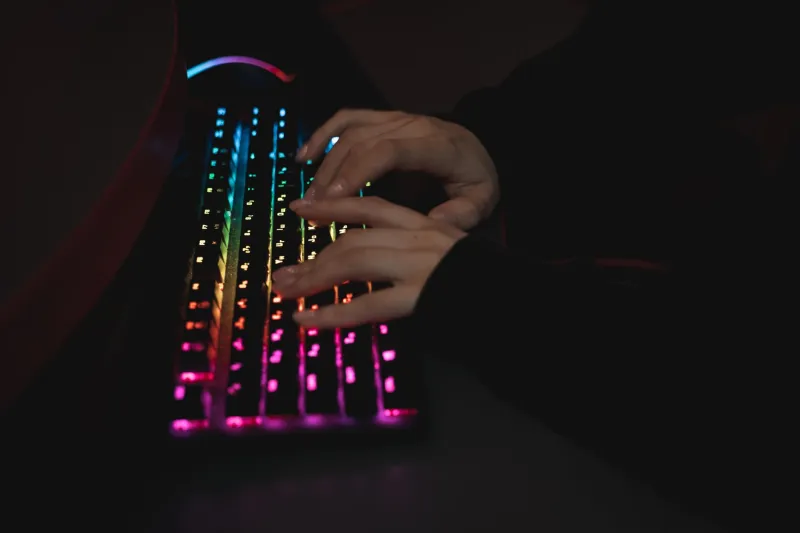
You sit down, open a browser, type in a password. Routine. Forgettable. The kind of thing you do forty times a day without thinking. But somewhere between the first keystroke and the last, a quiet measurement is happening — one that has nothing to do with what you typed and everything to do with how you typed it.
This is keystroke dynamics. And if you've never heard of it, that's kind of the point.
The Rhythm Nobody Taught You to Have
Every person who types has an unconscious cadence. The tiny gap between pressing the "s" and releasing it. The slight hesitation before a capital letter. The speed difference between your dominant hand's fingers and the slower ones. How long your thumb lingers on the spacebar. None of this is intentional — it's the accumulated muscle memory of years of practice, shaped by your neurology, your keyboard habits, your anxiety level on any given afternoon.
Behavioral biometrics researchers call this your "typing rhythm" or, more formally, your keystroke dynamics profile. And the wild thing is: it's remarkably stable. Studies going back to the 1980s — yes, this isn't new — showed that individuals could be re-identified by their typing patterns with accuracy rates that would make a lot of password systems blush.
What's changed is the scale. And the deployment.
Who's Already Using This
Let's start with the financial sector, because that's where a lot of this got normalized without much public debate.
Several major US banks and fintech platforms have quietly integrated behavioral biometric systems into their login flows. You're not told about it. There's no pop-up that says "we are now measuring the rhythm of your keystrokes." It happens in the background, layered underneath whatever two-factor authentication you're already using. The pitch to banks is simple: if someone steals your password, they can't steal your typing pattern. The system flags the login as suspicious not because the password was wrong, but because the hands were wrong.
Companies like BioCatch, TypingDNA, and Behaviosec have built entire business models around this. BioCatch, which has raised hundreds of millions in funding, claims to analyze over 2,000 behavioral parameters — including not just how you type but how you move a mouse, how you scroll, how you hold a phone. Their clients include some of the largest financial institutions in the country.
This isn't fringe tech. It's already inside systems you use every day.
The Government Angle Nobody's Talking About Enough
Corporate surveillance is one thing. Government use is a different conversation entirely.
The Department of Defense and various intelligence-adjacent agencies have funded research into continuous authentication — the idea that a system doesn't just verify who you are when you log in, but keeps checking throughout a session, constantly re-confirming your identity based on ongoing behavioral signals. Typing rhythm is central to this.
The logic makes a certain cold sense for high-security environments. If someone gains physical access to an already-logged-in terminal, continuous behavioral monitoring would theoretically catch the switch. But the same infrastructure, applied broadly, starts to look a lot less like security and a lot more like a surveillance layer that never turns off.
And unlike a password, you can't change your typing rhythm. You can't issue yourself a new one after a breach. It's not a credential you hold — it's a pattern you are.
Why This Is Harder to Escape Than You Think
Here's where it gets genuinely strange.
Most privacy countermeasures work by obscuring or replacing an identifier. You use a VPN to mask your IP. You use a pseudonym to obscure your name. You clear cookies to erase tracking tokens. These are substitution strategies — swap the identifier for something less revealing.
Keystroke dynamics doesn't work that way. There's no substitute. You can try to type deliberately slowly, or with deliberate irregularity, but sustained behavioral disruption is cognitively exhausting, and the moment you relax into natural typing, the pattern resurfaces. Researchers have demonstrated that even users who know they're being profiled and actively try to type differently still produce recognizable patterns within a few minutes.
Some privacy advocates have experimented with hardware-level solutions — devices that introduce randomized micro-delays at the keyboard firmware level before signals reach the OS. These exist, but they're niche, technical, and mostly impractical for everyday use. For the average person sitting at a work laptop or scrolling on a phone, there is no off switch.
The Consent Problem Hiding in Plain Sight
Ask most Americans whether they've consented to having their typing rhythm collected and analyzed, and you'll get a blank stare. That's not ignorance — it's a reasonable response to a disclosure system that buries this stuff in terms-of-service language nobody reads.
Privacy policies that mention "behavioral data" or "interaction data" often technically cover keystroke dynamics without ever using that phrase. The FTC has started paying more attention to biometric data collection in recent years, and a handful of states — Illinois being the most aggressive with its Biometric Information Privacy Act — have tried to put guardrails on this. But federal-level protection specifically covering behavioral biometrics remains patchy at best.
Meanwhile, the collection continues.
What the Signal Says About You
Here's the part that doesn't get discussed enough: keystroke dynamics doesn't just identify you. It can characterize you.
Research has suggested that typing patterns can reveal stress levels, cognitive load, even early indicators of neurological changes associated with conditions like Parkinson's disease or multiple sclerosis. There are legitimate medical applications here — some researchers are exploring keystroke analysis as a low-cost, passive screening tool.
But that same data, in the hands of an employer, an insurer, or an advertiser, opens up a different set of questions. If your typing rhythm on a Monday morning reveals elevated stress compared to baseline, what does that mean for how a platform serves you content? What does it mean for a performance management system that's watching your productivity?
The technology doesn't care about intent. It just measures.
Signals You Didn't Know You Were Sending
There's something almost poetic — in a deeply uncomfortable way — about the fact that the most intimate identifier being collected right now isn't your face or your voice. It's the unconscious rhythm of your hands doing something as ordinary as writing an email.
You didn't choose that rhythm. You didn't perform it for anyone. It just emerged, over years, from the specific and unrepeatable way your brain learned to talk to your fingers. And now it's in a database somewhere, attached to a profile, doing work you never authorized it to do.
The signals from the fringe have been saying this for a while. The mainstream is only just starting to listen.