Drawn From Memory: The Americans Quietly Replacing QR Codes With Paper and Trust
Somewhere in Portland, Oregon, there's a farmers market that doesn't have a website. No Instagram page, no Google Maps pin, no QR code on a sandwich board pointing you to a digital menu. If you want to find it, someone has to tell you where it is. And if you want to come back next week, you'd better have written down the address yourself — because nobody's going to text it to you.
This isn't an accident. It's a choice.
Across the country, a loose, largely invisible network of people is making the same choice in different ways. They're handing out photocopied zines instead of links. They're sketching directions on napkins. They're building community resource guides in spiral notebooks and leaving them on coffee shop counters. They are, by almost every measurable standard, opting out — not just of QR codes specifically, but of the entire trackable, scannable, data-harvesting layer that now sits on top of nearly every public interaction in American life.
The Code That Knows Too Much
To understand why someone would reject a QR code, you have to understand what a QR code actually does — which is more than most people realize.
Scanning one doesn't just open a link. Depending on how it's configured, that single gesture can hand over your device type, operating system, approximate location, IP address, and the time of day you scanned it. The company or individual who generated the code often receives all of this before you've even seen the page it sends you to. Dynamic QR codes — the kind businesses use when they want to update the destination later — log every scan in real time. They're not just shortcuts. They're little data collection checkpoints dressed up as convenience.
For most Americans, this is a trade-off they've decided is fine. But for a growing number of people, especially those who've spent time reading about behavioral tracking, data brokers, or the quiet ways commercial surveillance operates at street level, it's a trade-off that stopped feeling acceptable.
"I started noticing that every time I scanned something, I was basically announcing myself," said one woman in Austin who runs a neighborhood skill-share network entirely through printed flyers and a physical sign-up sheet kept at a local library branch. "I didn't want to announce myself anymore. I just wanted to share information with my neighbors."
Paper Doesn't Phone Home
The appeal of analog alternatives isn't nostalgia — or at least, it isn't only nostalgia. It's function. A hand-drawn map can't be deactivated by a server going down. A printed directory doesn't require anyone to download an app. A word-of-mouth recommendation doesn't generate a data point that gets sold to a marketing platform six months later.
These aren't fringe concerns. They're the logical conclusions of paying attention to how digital infrastructure actually operates.
In cities like Chicago, Seattle, and Denver, small pockets of people have started organizing what they loosely call "analog-first" community spaces — venues, markets, meetups, and mutual aid networks that deliberately avoid any system requiring a scan, a login, or a tracked click. Some of these groups communicate through physical bulletin boards. Others use printed newsletters distributed by hand. A few have revived the old practice of phone trees, where information travels person to person through actual phone calls rather than group chats that live on someone else's servers.
None of these communities are trying to be dramatic about it. Most of them would bristle at being called a movement. But the pattern is real, and it's spreading.
The Invisible Community Problem
Here's what makes this particularly interesting from a cultural standpoint: communities that exist outside digital infrastructure are, by definition, invisible to the systems designed to map and monetize human behavior. They don't show up in app analytics. They don't generate social media engagement. They don't produce the kind of data footprint that algorithms can detect, categorize, and serve ads against.
In a world where visibility and discoverability are treated as inherently valuable — where being findable online is practically synonymous with existing — choosing to be unfindable is a genuinely radical act. Not radical in a loud, manifesto-waving sense. Radical in the quieter sense of going to the root of something and pulling.
What these analog holdouts are pulling at is the assumption that connection requires a platform. That community requires an app. That sharing information requires a system that logs who shared what with whom and when.
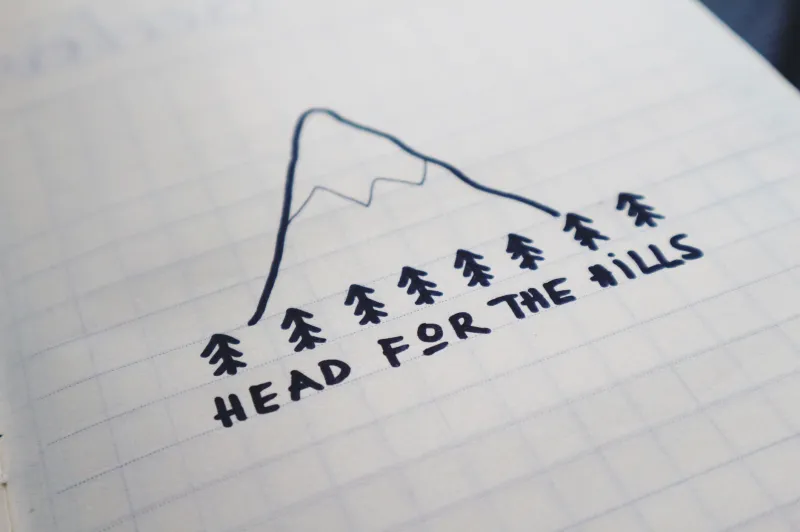
A hand-drawn map shared between two people contains the same information as a Google Maps link. But only one of them tells a third party that the exchange happened.
What Gets Lost, What Gets Found
It would be dishonest not to acknowledge the friction. Analog systems are slower. They require more effort. They don't scale. If you miss the physical newsletter, you miss the information. If you weren't in the room when the directions were given, you're not going anywhere.
For some people, that friction is a dealbreaker. For others, it's quietly becoming the feature rather than the bug.
"There's something different about information you had to work a little bit to get," said one man in Philadelphia who distributes a monthly printed guide to local independent businesses — no websites listed, just addresses and hours. "You pay more attention to it. You remember it. And the people who find it actually wanted to find it."
That last part matters more than it might seem. One of the side effects of algorithmic content delivery is that communities get assembled by recommendation engines rather than by genuine shared interest. You end up surrounded by people the platform decided you should know, in spaces the platform decided you should visit. Analog discovery — following a hand-drawn arrow, asking a stranger, reading a photocopied flyer stapled to a telephone pole — selects for a different kind of participant. Someone who was curious enough to follow an unfamiliar thread.
The Signal in the Paper
ROCEDTP has spent a lot of time paying attention to the edges of digital culture — the places where the mainstream signal breaks up and something stranger, more deliberate, starts coming through. The analog holdout movement, if you want to call it that, is one of those places.
It's not anti-technology in any pure sense. Most of the people doing this still use smartphones. They still have email. They're not building cabins in the woods and going off-grid. They're making specific, targeted refusals — drawing a line not around technology in general, but around the particular infrastructure of trackable interaction that's colonized everyday life so thoroughly most people have stopped noticing it's there.
A QR code is a small thing. A hand-drawn map is a small thing. But the choice between them is a statement about who gets to know that you showed up — and who doesn't.
Some people have decided the answer to that question should be: just the people in the room.