Glyphs in the Noise: How Fringe Internet Communities Built a Visual Language Nobody Else Can Read
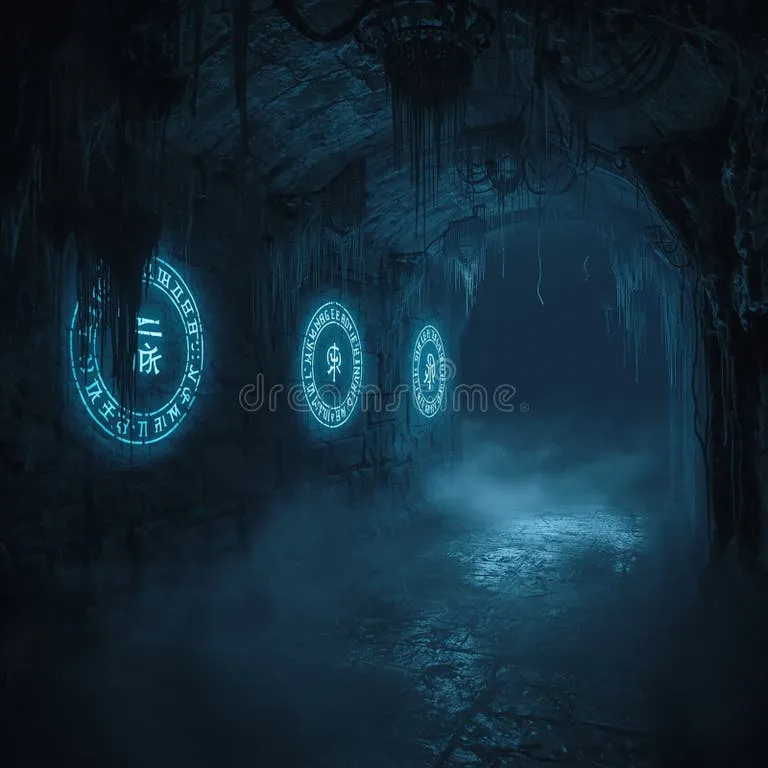
Photo: mysterious symbols glowing screen dark underground internet aesthetic, via thumbs.dreamstime.com
There's a particular shade of green that means something specific in certain corners of the internet. Not forest green. Not lime. A specific, slightly desaturated yellow-green that, if you know, you know — and if you don't, it just looks like a color. That's the whole architecture of underground internet aesthetics in one example: meaning that is invisible to outsiders and unmistakable to insiders.
Fringe online communities have always developed their own visual vocabularies. But in the last several years, as platform moderation has become more aggressive and more sophisticated, the visual language of these spaces has evolved from in-joke territory into something closer to functional code. Understanding it requires thinking about semiotics, about community formation, and about the specific pressures that come from trying to communicate in spaces that are actively surveilled.
The Basics: Why Visuals Work Where Words Fail
Content moderation, at scale, is primarily a text operation. Keyword detection, natural language processing, behavioral pattern analysis — the infrastructure is built around written language. Images are harder. Meaning embedded in color combinations, symbolic arrangements, and abstract iconography is harder still. You can train a classifier to flag certain words. Training one to understand that a specific hand gesture has been adopted as a community identifier by a group that doesn't share that meaning publicly is a substantially more complex problem.
This is not an accident. The communities that have developed the most sophisticated visual languages are often the ones that have experienced the most aggressive moderation pressure. The visual code develops in direct response to the enforcement environment — a kind of adaptive camouflage for meaning-making.
"When the words get you banned, you stop using words," is how one longtime observer of fringe internet culture put it in a community discussion thread. The sentiment captures the basic dynamic cleanly.
Color as Credential
Color is one of the most efficient carriers of subcultural meaning on the internet because it operates below the threshold of explicit content and above the threshold of pure abstraction. A specific palette can signal membership without stating anything directly.
Different communities have colonized different corners of the color wheel over the years. The aforementioned yellow-green became associated with a specific strain of ironic nihilism that emerged from certain imageboards around 2016. Washed-out pastels — particularly in combination with degraded, VHS-style visual noise — got adopted by aesthetic communities that positioned themselves as rejecting corporate digital polish. Deep purples and blacks with occasional neon accent colors became visual shorthand for communities interested in occult-adjacent content, esoteric philosophy, or what you might broadly call "hidden knowledge" aesthetics.
None of these associations are fixed or universal. Subcultural aesthetics drift, get appropriated, get ironically reclaimed. But at any given moment, color choices in community-created graphics function as a rough credential — a signal that the creator has spent enough time in the right spaces to have absorbed the palette.
The Icon Library: Recurring Symbols and What They're Doing
Beyond color, fringe internet communities have developed a shared library of recurring symbols that carry layered meaning. Some started as jokes and calcified into genuine identifiers. Some were deliberately designed as in-group markers from the start. Some were borrowed from historical, religious, or occult traditions and recontextualized in ways that would confuse their original sources considerably.
The all-seeing eye appears constantly across communities that have essentially nothing else in common — anti-establishment political groups, esoteric aesthetic communities, ironic meme culture, and genuine conspiracy-adjacent spaces all reach for it. Its ubiquity makes it almost meaningless as a specific identifier, but its persistence points to something real: these communities are drawn to symbols of hidden observation, of knowledge that is watched and watching.
The ouroboros — the snake eating its own tail — shows up in communities preoccupied with cycles, with systems that reproduce themselves, with the idea that conventional narratives are loops rather than lines. In certain corners of the internet it's become visual shorthand for a specific kind of structural cynicism.
Numerology runs through a lot of this. Specific number combinations appear as watermarks, as usernames, as subtle elements in image compositions. The meaning is often layered — a number that means one thing in one community gets adopted by another with a different but adjacent connotation, and the original community either accepts the drift or develops a new marker to replace it.
The Aesthetics of Degradation
One of the more interesting visual trends across multiple fringe communities is the deliberate embrace of degraded, lo-fi, or "broken" aesthetics. Scan lines. Compression artifacts. Distorted fonts. Images that look like they were screenshotted from a dying CRT monitor. This aesthetic vocabulary does several things simultaneously.
First, it signals opposition to corporate digital polish. The clean, high-resolution, carefully designed visual language of mainstream platforms reads, to these communities, as a marker of institutional control. Deliberately ugly or degraded content is a refusal of that aesthetic contract.
Second, it creates friction. Content that looks like noise is harder to process, harder to classify, harder to evaluate quickly. In an attention economy where everything is optimized for instant legibility, choosing illegibility is a form of resistance.
Third, and maybe most interestingly, it creates a kind of authenticity signal. Anyone can make clean, polished content. Making something that looks deliberately broken requires knowing that the brokenness is the point — which requires community context that outsiders don't have.
Platform Whack-a-Mole and the Limits of Visual Moderation
Platforms have gotten better at recognizing known symbols and flagging content that uses them. But the nature of symbolic language is that meaning migrates. When a specific image or symbol gets associated with content that violates platform policies, communities simply shift to adjacent imagery that carries the same meaning within the group but lacks the documented association that triggers automated review.
This creates a cycle that researchers who study online extremism have described as "symbol laundering" — the continuous replacement of flagged visual elements with functionally equivalent ones that haven't yet accumulated enough association to trip moderation systems. The meaning stays constant while the container keeps changing.
For platforms trying to moderate at scale, this is a genuinely difficult problem. You can build a classifier for symbols you've already documented. You can't easily build one for meaning that is constructed through community context and shifts faster than you can catalog it.
Reading the Room You Can't See
The visual language of fringe internet communities is, in a real sense, a mirror of the pressures those communities operate under. The more surveillance, the more the language goes nonverbal. The more moderation, the more the meaning migrates to carriers that moderation can't easily reach. The aesthetics aren't arbitrary — they're functional responses to a specific environment.
Understanding that doesn't require endorsing what any particular community is doing with its visual vocabulary. But it does require taking seriously the idea that when communities develop elaborate codes for communication, they're usually responding to something real — even if what they're saying in that code is something you'd rather not hear.
The symbols are in the noise. They've always been there. The question is whether you know how to look.