Dead Air: America's Forgotten Towers and the Voices That Never Stopped Transmitting
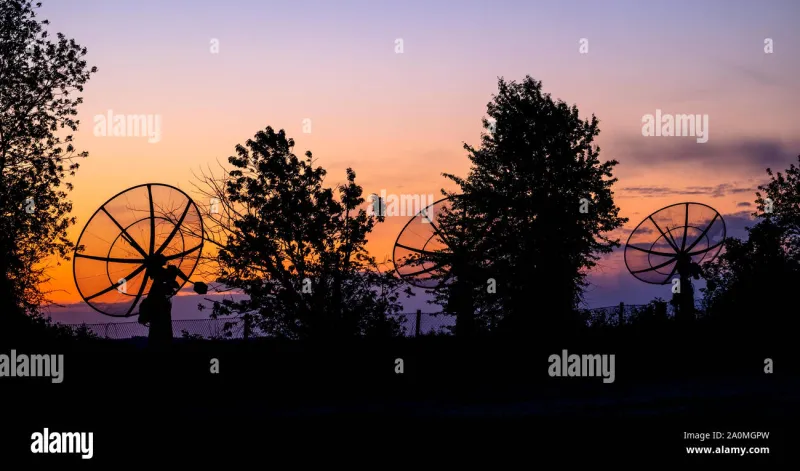
Photo: abandoned radio broadcast tower rusty rural America sunset atmospheric, via c8.alamy.com
The Tower at the Edge of Town
Drive far enough outside almost any mid-sized American city and you'll eventually see one. It might be half-collapsed, held together by guy-wires gone orange with rust. It might be standing perfectly upright in a field, antenna assembly still intact, a red aircraft warning light that no one has bothered to disconnect still blinking at dusk like a mechanical heartbeat. These are the ghost towers — the remnants of America's first great broadcast infrastructure boom, now scattered across the landscape like monuments to a communication era that moved on without them.
Most people drive past them without a second thought. A smaller group pulls over.
A Brief History of Abandonment
America's broadcast tower network was built in waves, starting in the 1920s with the rise of commercial AM radio and accelerating through the post-war television boom of the late 1940s and 50s. By the time the FCC had mapped out the full commercial broadcast landscape, the country was studded with thousands of transmission sites — hilltop arrays, flat-land megastructures, urban rooftop installations — each one a node in what was, for its time, the most sophisticated mass communication network ever built.
Then things changed. FM overtook AM. Cable gutted local television. The digital transition of 2009 rendered dozens of analog TV transmitters legally obsolete overnight. Consolidation swallowed local stations. The economics of maintaining remote transmission infrastructure stopped making sense for companies that were already struggling to stay solvent. And so the towers were left.
Not demolished — that costs money too. Just left. Licenses lapsed. Equipment was sometimes stripped, sometimes not. The FCC's database of inactive or administratively terminated broadcast licenses runs into the thousands, a bureaucratic graveyard that maps almost perfectly onto the physical landscape of rusting steel and dormant coaxial cable.
"There's no federal mandate to take these things down," explains a retired broadcast engineer named Carl Dessler, who spent 30 years working on transmission infrastructure across the Midwest before retiring to what he describes as "a more enjoyable kind of antenna work." "If the land is leased, the owner might eventually force a takedown. But a lot of these towers are on land the station owned outright, and when the company folded or got absorbed, the property just... sat."
The Frequencies Are Never Truly Empty
Here's the thing about a dormant frequency: the physics don't care that a license has expired. The spectrum doesn't close. The band doesn't go dark. It just goes quiet — and quiet, to certain kinds of people, is an invitation.
Pirate radio has a long, complicated, deeply American history. Low-power unlicensed FM operations have been a fixture of urban communities since at least the 1980s, broadcasting everything from Caribbean music in New York neighborhoods to radical political content in college towns across the South and Midwest. The FCC pursues enforcement actions against unlicensed operators with varying degrees of enthusiasm depending on the administration and available resources, but the practice has never been stamped out.
What's less documented is the activity around abandoned infrastructure specifically. Some operators, hobbyists rather than commercial pirates, have discovered that defunct transmission sites sometimes still have functional equipment — or at least functional power connections — that can be repurposed. Others simply set up portable transmitters in proximity to old tower sites, a practice that has no particular technical advantage but carries an obvious symbolic weight.
"There's something about transmitting from a dead tower," says a licensed amateur radio operator who runs a podcast about fringe broadcast history and asked to be identified only as "Threshold." "It feels like you're reanimating something. Like you're giving the frequency back its voice."
What Gets Transmitted
The content coming out of these ghost-band operations is as varied as the people behind them. Some is mundane — music, talk, local news that mainstream outlets have abandoned. Some is stranger.
Numerical broadcasts, sometimes called numbers stations, have a documented history on shortwave frequencies, associated historically with Cold War-era espionage communication. Whether any of the odd, repetitive transmissions that radio hobbyists occasionally log near defunct AM towers are genuine numbers stations, amateur experiments, or something else entirely is genuinely unclear. The FCC doesn't comment on specific intercepts. The hobbyists who log them trade theories on forums with names that would feel right at home in the ROCEDTP ecosystem.
There are also the experimenters — engineers, artists, and academics who have obtained special experimental licenses from the FCC to conduct transmissions on otherwise dormant frequencies. These licenses, designated Part 5 experimental authorizations, cover everything from atmospheric research to artistic radio projects. A handful of these license holders have specifically sought out defunct broadcast sites as venues for their work, treating the old infrastructure as both a technical resource and a conceptual frame.
One such project, conducted by a media arts collective in the Great Plains region, spent two years transmitting field recordings — wind, insects, the ambient sound of the landscape — from a dormant 50,000-watt AM transmitter site in rural Nebraska. The signal reached, on good nights, several states in every direction. Whether anyone was listening was, according to the project's documentation, somewhat beside the point.
The Listeners
But people are listening. That's the part that surprises newcomers to this world.
The shortwave and AM hobbyist community in the US is smaller than it was at its peak, but it's not gone. DXers — enthusiasts who compete to log the most distant or unusual radio signals — maintain meticulous logs and share intercepts through mailing lists and forums that have operated continuously since the early days of the internet. When something unusual turns up on a frequency that should be dead, the community notices.
There are also the scanner enthusiasts, the SDR (software-defined radio) experimenters who run always-on monitoring setups from home computers, and the occasional academic researcher studying broadcast archaeology. They form an informal, distributed listening network — not coordinated, not organized, but collectively covering an impressive slice of the spectrum at any given moment.
"The tower might be abandoned," Dessler says, "but the frequency is public. Always has been. Anyone with a receiver can hear what's on it." He pauses. "Most of the time, nothing is. But most of the time isn't all of the time."
Signal Persistence
There's a metaphor hiding in all of this, and it's not a subtle one. The infrastructure of mass communication was built to serve specific interests, at a specific moment, for a specific economic model. When that model collapsed, the infrastructure didn't vanish — it just became available for other purposes, other voices, other messages.
The fringe always finds the abandoned frequencies. That's not a new observation. But standing next to a rusting tower in a field somewhere in middle America, watching a light blink that no one officially maintains anymore, it feels less like a metaphor and more like a fact about how communication actually works.
Some signals are too stubborn to die. The towers are proof.