The Hum That Outlived the Store: Why Field Recordists Are Taping America's Empty Malls
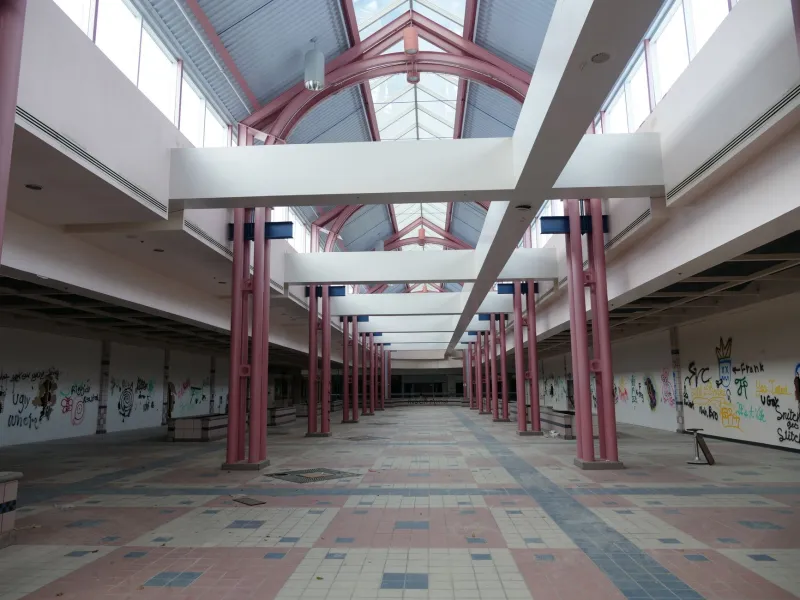
The Building Is Still Humming
Stand outside the sealed entrance of a dead anchor store and give it thirty seconds. You will hear something. Not ghosts, not voices, just the building doing its involuntary work: air handlers pushing through ductwork sized for a crowd that stopped coming years ago, a roof drain ticking, the low 60-hertz breath of an electrical panel that nobody has bothered to shut off.
That sound is what a loose network of American field recordists has spent the last few years chasing. They drive to shuttered malls in Ohio and Georgia and downstate Illinois with small recorders, tripods, and a stubborn affection for places the rest of the country has agreed to forget. Then they upload the results to public archives, tag them by county, and move on to the next empty parking deck.
This is not urbex with a microphone. Nobody is climbing fences for the thrill. The appeal is quieter and, honestly, a little sadder: these buildings have a soundtrack, and it is about to be deleted.
What They're Actually Capturing
Ask a recordist what's in the file and you get a list that sounds like a joke until you hear it. The three-note chime of a mall-wide paging system still cycling through its test sequence. The flat slap of a revolving door someone forgot to lock. Rain on a skylight built in 1978, which sounds different from rain on a skylight built in 2004, because the glass and the frame and the seal are all different.
There is also the mallsoft connection, and everyone in the scene knows it. The vaporwave offshoot that smears half-remembered department store music into slow, echo-heavy loops has been around since the early 2010s. What's changed in 2026 is that the raw material is getting scarce. You cannot sample a food court that has been reduced to a graded dirt pad, and plenty of them have. Eastfield Mall in Massachusetts came down. Century III outside Pittsburgh spent years being picked apart. Owings Mills is a strip center now.
So people started recording instead of sampling. The result sits somewhere between archival work and folk art.
The Map Is the Point
A recording nobody can find is just a big file on a hard drive. That's where the public sound maps come in. Sites like Radio Aporee have hosted geotagged field recordings for years, and the dead-mall uploads now form their own weird archipelago on the map: pins scattered across the Midwest and the Sun Belt, each one a two-minute window into a room with no people in it.
Freesound and the Internet Archive pick up the overflow. Amateur archivists bundle their mall sets into downloadable collections with names like "Interior Retail Ambience, 2019–2026" and release them under permissive licenses, which means a student filmmaker in Tucson can drop a genuine JCPenney corridor into a project for free.
The bigger shift is organizational. What used to be solitary hobbyists trading links on forums is now semi-formal: shared spreadsheets of sites, gear recommendations (a Zoom H1n if you're broke, an H6 if you're serious, a pair of decent wind muffs no matter what), and a rough code of conduct that boils down to don't wreck anything, don't lie about where you were, and don't post a file that could get someone's name attached to a trespass.
Why a Fridge Hum Beats a Polished Feed
Here's the part the recordists themselves get shy about, because it sounds pretentious until you sit with it. These files feel honest.
Scroll through a social feed and everything is mixed, lit, color-graded, scored. Then put on headphones and listen to an empty corridor where the only event in ninety seconds is a fluorescent ballast cycling on. Nothing is optimizing itself for you. The room doesn't care whether you stay. That indifference is oddly restful, and it's probably why the recordings travel well beyond the small circle of people who made them. The comments on these uploads are full of people saying some version of I used to work there or I can smell this.
Dan Bell's dead mall videos built an audience on that same ache a decade ago. Audio just strips out the last layer of presentation.
Listening Without Being a Jerk
The etiquette matters, because a lot of these locations sit on somebody's liability spreadsheet. The scene's informal rules are consistent: go where access is legal or explicitly granted, ask property managers when you can, stay out of active construction, and never publish a recording that reveals a security routine or a code.
Practical stuff, too. Record early morning, when traffic noise is lowest and the building's own systems are loudest relative to everything else. Get close to the source. Use a windshield even indoors, because HVAC exhaust creates its own draft. Log the date, the weather, and the room, since context is half the value of an archive.
And keep the raw file. The processed version is nice for posting. The unedited one is the actual artifact, and twenty years from now it will be the only witness left that the place sounded like anything at all.
What Gets Saved
Nobody in this scene thinks they're preserving culture in the capital-C sense. It's a food court. It's a Spencer's Gifts that sold a lava lamp to somebody's dad in 1994. But the strip mall and the enclosed mall and the arcade were the actual architecture of American teenage life for about four decades, and their sound is vanishing faster than their photographs, because sound doesn't leave a foundation behind.
Demolition crews don't announce a schedule for the hum. It just stops one day. The people with the recorders are trying to make sure it stops somewhere with a timestamp attached.